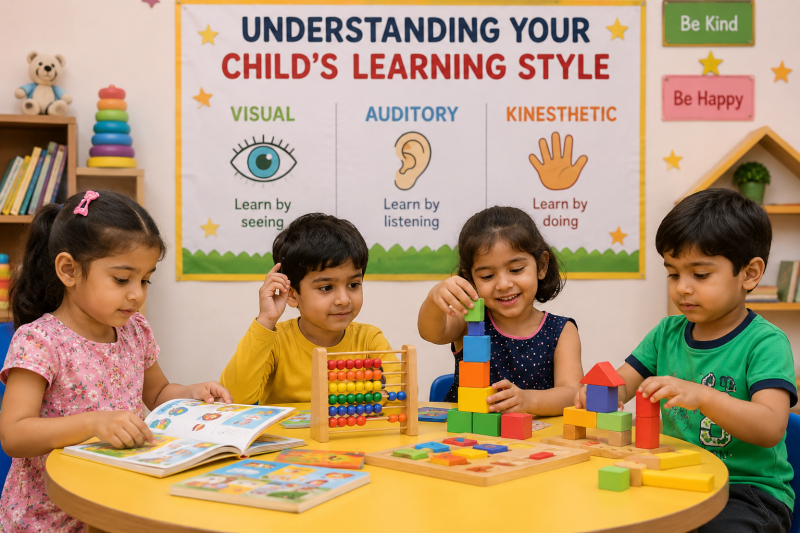
Every child learns in their own unique way. Understanding your preschooler's learning style can help make learning more enjoyable, effective, and engaging. When parents and teachers recognize how a child learns best, they can provide experiences that build confidence, curiosity, and a lifelong love of learning.
👀 Sight-Based Learners
Visual learners are children who learn best by seeing information. They understand and remember concepts more easily when they are presented through pictures, images, colors, symbols, demonstrations, and other visual aids. For preschoolers, visual learning plays an important role because young children are naturally attracted to bright colors, illustrations, and visual experiences.
Visual learners often observe their surroundings carefully and can remember details from things they have seen. They may find it easier to understand a new concept when they can look at a picture or watch someone demonstrate it rather than simply listening to an explanation.
How to support them: Use picture books, flashcards, puzzles, and colorful learning materials.
👂 Hearing-Based Learners
Hearing based learners are children who learn best through hearing and listening. They understand and remember information more effectively when it is presented through spoken words, conversations, songs, rhymes, and sounds. For preschoolers, auditory learning is especially important because language development is rapidly growing during these early years.
hearing based learners often enjoy listening to stories, singing songs, participating in discussions, and repeating information they hear. They learn by processing sounds and spoken language, making listening activities an essential part of their learning experience.
How to support them: Read together regularly, sing educational songs, and encourage conversations.
✋ Tactile Learners
Tactile learners are children who learn best through movement, touch, and hands-on activities. Rather than simply listening to explanations or looking at pictures, these children understand concepts more effectively when they can actively participate in the learning process. For preschoolers, kinesthetic learning is especially important because young children are naturally energetic, curious, and eager to explore their world through physical experiences.
Tactile learners enjoy learning by doing. They like to touch, build, move, experiment, and explore. Through active participation, they develop a deeper understanding of concepts while strengthening important physical and cognitive skills.
How to support them: Provide opportunities for hands-on learning, sensory activities, and active play.
Why It Matters
Understanding your child's learning style helps:
✔ Build confidence and motivation - When children learn in a way that matches their strengths and interests, they feel more capable and successful. Positive learning experiences help preschoolers believe in their abilities, encouraging them to try new activities and overcome challenges. As their confidence grows, they become more motivated to participate, explore, and develop a lifelong love of learning.
✔ Improve communication and understanding - Understanding a child's learning style helps parents and teachers communicate in ways that are easier for the child to understand. When information is presented in a way that matches how a child learns best, they can express their thoughts more clearly, follow instructions more effectively, and develop stronger language and communication skills. This leads to better understanding, stronger relationships, and more successful learning experiences.
✔ Make learning more enjoyable - When learning activities match a child's interests and preferred learning style, learning becomes more fun and engaging. Children are more likely to participate enthusiastically, stay focused, and enjoy exploring new ideas. Positive and enjoyable learning experiences help preschoolers develop curiosity, creativity, and a love of learning that can last a lifetime.
✔ Support academic and personal growth - Understanding a child's learning style helps them develop important academic skills while also building personal qualities such as confidence, independence, and problem-solving abilities. When children learn in ways that suit their strengths, they are better able to achieve learning goals, adapt to new challenges, and grow into confident, capable learners.
✔ Encourage a positive attitude toward education - When children experience success and enjoyment in learning, they begin to view education as something positive and rewarding. Learning activities that match their learning style help reduce frustration, increase confidence, and make learning more meaningful. This encourages preschoolers to be curious, enthusiastic, and eager to learn, laying the foundation for a lifelong love of education.
Remember, most children use a combination of learning styles. The key is to observe, encourage, and provide a variety of learning experiences that help your child thrive.
"When learning is tailored to a child's strengths, every day becomes an exciting opportunity to discover, grow, and succeed." 🌟
Add comment
Comments