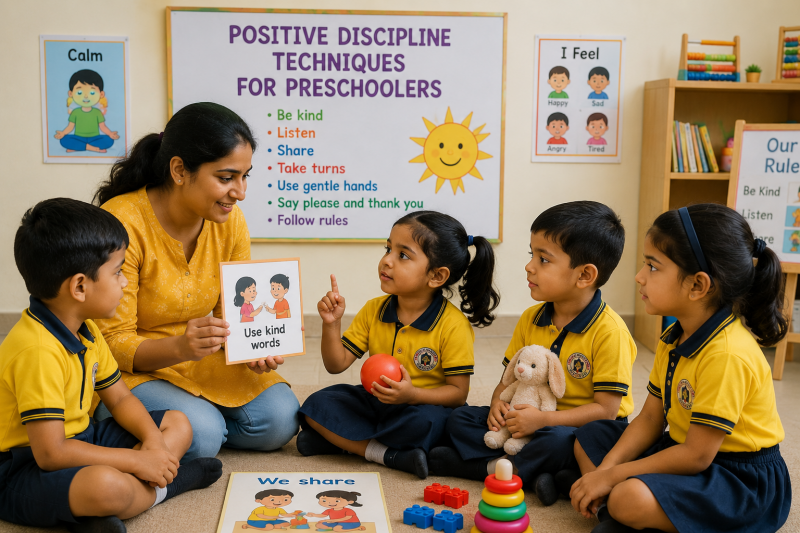
The preschool years—roughly ages three to five—are a whirlwind of growth. Children this age are developing language, testing independence, and learning to manage big emotions with a brain that's still years away from full impulse control. It's no surprise that tantrums, defiance, and meltdowns are part of daily life for most families during this stage.
Positive discipline offers an alternative to punishment-based approaches like yelling, spanking, or time-outs used as isolation. Instead, it focuses on teaching children the skills they need to manage their behavior, while maintaining a warm, respectful relationship between parent and child. Research in child development consistently shows that this approach builds emotional regulation, self-esteem, and cooperation more effectively than punitive methods—and it does so without damaging trust.
Here's a closer look at what positive discipline actually looks like in practice.
The Philosophy Behind Positive Discipline
Positive discipline rests on a simple but important idea: behavior is communication. A preschooler who hits, screams, or refuses to listen isn't being "bad"—they're often overwhelmed, tired, hungry, or lacking the words to express what they need. The goal of discipline, then, isn't to punish the child into submission but to teach them better ways to handle the situation next time.
This doesn't mean permissiveness. Positive discipline still involves firm limits and consequences—it just delivers them with respect rather than shame, and with teaching rather than fear.
Core Techniques
- Connect Before You Correct
Before addressing a behavior, take a moment to acknowledge the child's feelings. Kneeling to their eye level and saying something like, "You're really upset that we have to leave the park," helps the child feel heard. Children are far more receptive to guidance once they feel understood, and this small step often prevents a situation from escalating into a full meltdown.
- Offer Limited Choices
Preschoolers are in the throes of asserting independence, and power struggles are common. Giving them a choice—within limits you've already decided are acceptable—can defuse conflict. Instead of "Put your shoes on now," try "Do you want to wear the red shoes or the blue ones?" This offers a sense of control without opening the door to endless negotiation.
- Use Clear, Simple Language
Long explanations and abstract instructions tend to go over a preschooler's head. Short, concrete, positively framed statements work best: "Feet stay on the floor" is more effective than "Don't put your feet on the couch," and far more effective than a vague "Be careful."
- Redirect Instead of Just Saying No
Young children often can't simply stop an impulse—they need something to do instead. If a child is throwing toys indoors, handing them a soft ball and pointing them toward an appropriate space to throw it acknowledges the underlying need to move and throw, while steering the behavior somewhere safe.
- Set Consistent, Predictable Routines
Preschoolers thrive on structure. Knowing what comes next—after breakfast we brush teeth, after dinner we read a book—reduces anxiety and the meltdowns that often come with uncertainty. When routines must change, giving a heads-up ("Today is a little different because...") helps children adjust.
- Use Natural and Logical Consequences
Rather than arbitrary punishments, positive discipline favors consequences connected to the behavior itself.
- Natural consequences happen without any adult intervention: if a child refuses a coat, they feel cold outside.
- Logical consequences are related but require a caregiver to enforce them: if a child throws toys, the toy is put away for the rest of the afternoon.
These teach cause-and-effect in a way that makes sense to a young child, rather than feeling like an unrelated punishment.
- Give Warnings Before Transitions
Sudden transitions are one of the most common tantrum triggers for this age group. A simple warning—"Five more minutes, then it's time to clean up"—gives a child time to mentally prepare and lets them finish what they're doing on their own terms.
- Praise Effort and Specific Behavior
Rather than generic praise ("Good job!"), naming the specific behavior reinforces what you want to see again: "You waited so patiently while I was on the phone" or "I noticed you shared your crayons with your sister." Specific praise helps children understand exactly which actions earned the recognition.
- Use Time-In Over Time-Out
Traditional time-outs isolate a child during a moment of emotional overwhelm—precisely when they most need help regulating. Time-in flips this: the caregiver stays close, helps the child calm down, and then works through the problem together once emotions have settled. This teaches self-regulation rather than simply suppressing the outward behavior.
- Validate Feelings While Limiting Behavior
One of the most useful phrases in a caregiver's toolkit is some version of: "It's okay to be angry. It's not okay to hit." This separates the emotion, which is always valid, from the action, which may not be acceptable. Over time, children learn that having big feelings isn't the problem—what they do with those feelings is what matters.
- Model the Behavior You Want to See
Preschoolers learn largely through imitation. A caregiver who takes a deep breath and says "I'm feeling frustrated, I need a minute" when stressed is teaching emotional regulation far more effectively than any lecture could. Children absorb far more from what they observe than from what they're told.
Things to Keep in Mind
- Repetition is normal. Preschoolers have limited impulse control and short memories for rules. Needing to repeat a boundary for the tenth time isn't a sign that positive discipline "isn't working"—it's developmentally expected.
- Consistency matters most. Children do best when caregivers respond to the same behaviors in similar ways. Mixed signals between parents, or between good days and bad days, tend to confuse rather than teach.
- Temperament varies. Some children need more structure, others need more room for autonomy within structure. Positive discipline isn't a rigid script—it's a set of principles that can be adapted to fit the child in front of you.
- It takes patience. Positive discipline is often slower to show results than punishment, because it's building long-term skills rather than producing instant compliance. The payoff tends to show up over months and years, not overnight.
The Bottom Line
Positive discipline isn't about being permissive or avoiding boundaries—it's about teaching preschoolers the emotional and behavioral skills they haven't yet developed, using respect and connection as the foundation. It asks more patience of caregivers in the moment, but it builds children who understand not just what behavior is expected, but why—a foundation that serves them well beyond the preschool years.
Add comment
Comments